
Leadership Styles and Theory: What Works in Practice?
Leadership in the cultural sector often takes a different form than in more traditional organizations. Teams are often small, organized around projects, and consist of a mix of staff members, creators, freelancers, and partners. This requires flexibility, clear communication, and the ability to engage people in the change process.
At the same time, there is no single “right” way to lead. Different situations and employees with their own needs call for different styles. That is precisely why it can be helpful to view leadership theories not as fixed rules, but as tools for making more conscious choices.
Different Leadership Styles
There are many different leadership styles. Some leaders focus primarily on structure and results, while others place greater emphasis on collaboration, autonomy, or development. Which style works best often depends on the team, the organization, and the situation. And, of course, it also depends on the leader themselves: which style suits them—or doesn’t.
Many leadership theories sound abstract, but are surprisingly familiar in practice. For example, Daniel Goleman describes six different leadership styles. Other commonly used styles stem, for example, from Hersey and Blanchard’s situational leadership model, the transformational leadership theories of James MacGregor Burns and Bernard Bass, and Robert Greenleaf’s servant leadership. Many of these theories overlap to some extent, but each places a different emphasis on aspects such as direction, collaboration, motivation, or development.
Below is a list of some common styles:
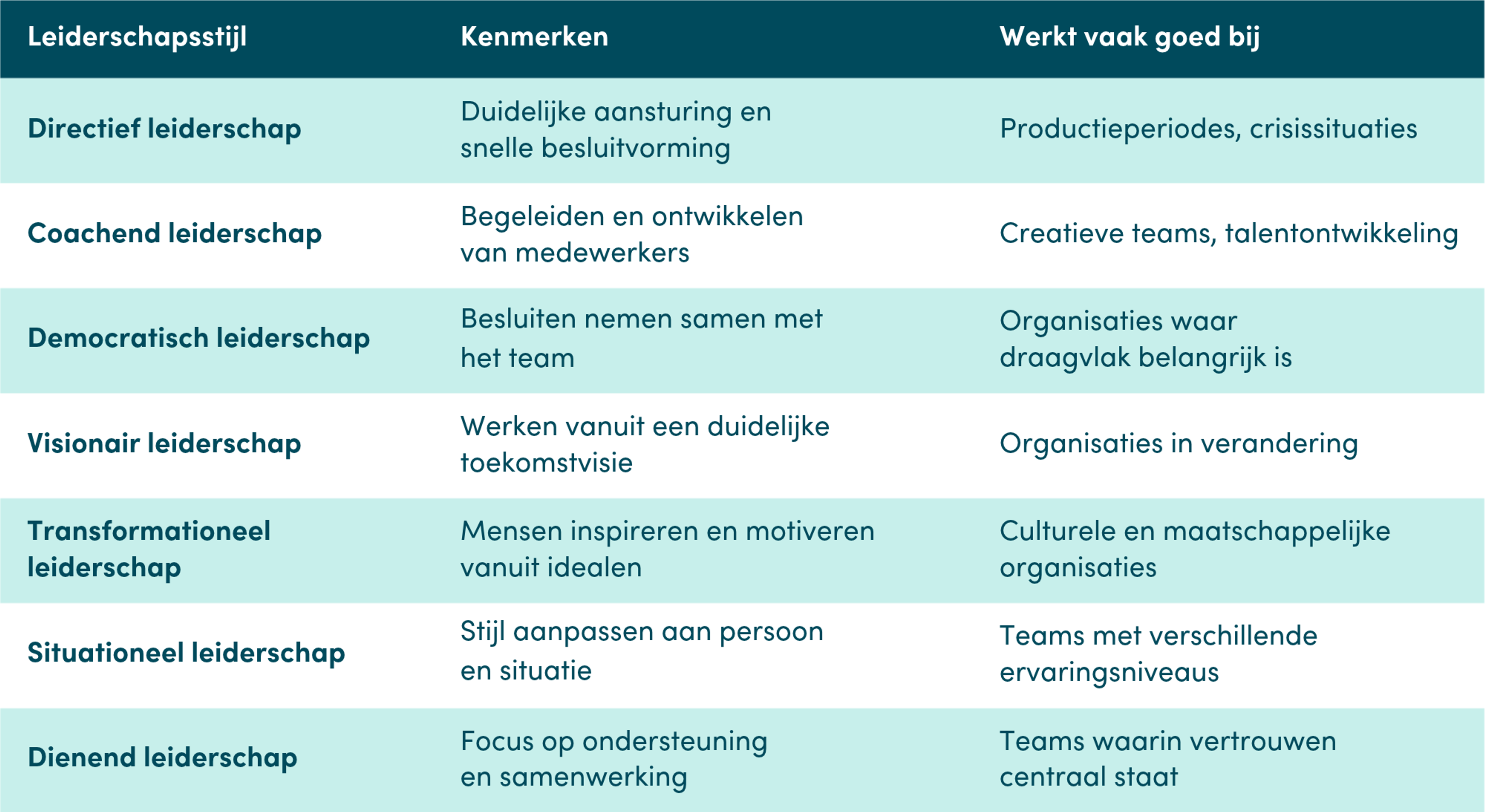
Coaching, democratic, and inclusive leadership styles are particularly common in cultural organizations, where collaboration and creativity are important. Transformational leadership is also common: in this style, leaders seek to rally people around a shared vision or mission.
At the same time, there is also a risk involved. Because of their deep commitment, teams in the cultural sector sometimes push themselves beyond their limits during busy production periods. Good leadership, therefore, also means setting clear expectations, establishing healthy boundaries, and paying attention to workloads.
💡 Tip: Generator Oost is a leadership program offered by Cultuur Academy for cultural professionals who want to grow in their roles as leaders, creators, or drivers within the sector.
What's the right fit for you and your organization?
Not every leadership style is a good fit for every organization. A small production company often has different needs than a large museum or performing arts venue. The stage an organization is in also plays a role. A startup sometimes needs clear direction, while an experienced team tends to function better with more autonomy.
It is therefore helpful to take a critical look at yourself and your organization:
- How are decisions made?
- How much structure does the team need?
- Where does energy—or, conversely, frustration—come from?
- What style suits the people you work with?
Organizational models can also help us examine this issue. For example, management thinker Margaret Wheatley describes organizations more as living networks than as rigid hierarchies. In his book *Reinventing Organizations*, Frederic Laloux describes other ways to structure an organization so that employees remain motivated and engaged. Within cultural organizations, where collaboration, creativity, and change are central, this perspective often aligns well. Consciously reflecting on leadership and organizational structure helps to find a better balance between structure and flexibility.
Leadership vs. Personal Leadership
Leadership is about how you guide, direct, or inspire others within an organization or team. Personal leadership, on the other hand, is about how you manage yourself: how aware you are of your behavior, communication, choices, and boundaries. These two are closely intertwined. The better you know yourself, the better you’re often able to lead others. How do you deal with stress or conflicts? Can you both receive and give feedback? And do you dare to make choices, even when they aren’t pleasant for everyone? Do you stand up for your employees, even when they make mistakes?
In the field of personal leadership, Ofman’s core quadrants are often used. This model helps provide insight into strengths, pitfalls, challenges, and aversions.
In a nutshell:
- A quality is something you're good at
- A pitfall arises when that quality goes too far
- A challenge is behavior that can help you continue to grow
- An allergy often develops in response to behavior that is contrary to your nature.
For example, an engaged leader may be inspiring, but may also have difficulty setting boundaries or letting go.
Leadership Is Always Evolving
Leadership isn’t a fixed method that you learn once and then apply in the same way forever. Teams change, organizations evolve, and societal expectations shift along with them. And you, as a leader, are also evolving. That’s why more and more (cultural) organizations are seeking forms of leadership that align with collaboration, inclusion, and shared responsibility. The loudest voice doesn’t automatically have to be the leader. Sometimes, good leadership lies precisely in listening, giving others space, and building trust.
💡 Tip: Cultuur Academy regularly organizes courses and training sessions on leadership, collaboration, and organizational development. Be sure to check out their offerings available upon request.
Read more
- Daniel Goleman on Leadership: A book by Daniel Goleman on different leadership styles and emotional intelligence.
- Goleman's Leadership Styles Explained: A Practical Explanation of Goleman's Six Leadership Styles.
- Transformational Leadership: Leadership Based on Vision, Inspiration, and Change.
- Ofman Model Core Quadrants for insight into strengths, pitfalls, challenges, and aversions.
- Generator Oost: A leadership programby Cultuur Academy for cultural professionals and creators.