Working Effectively in the Cultural Sector: How to Stay Organized
If you work in the cultural sector, you’re probably familiar with this: juggling multiple projects at once, tight deadlines, and collaborating with different people. Before you know it, everything feels urgent, and you lose sight of the big picture. Working effectively helps you bring calm to your workday, make better choices, and focus more on what really matters.
Take Control of Your Time
Working effectively doesn’t start with doing, but with pausing. Many cultural professionals are used to jumping right into action, when in fact a brief pause at the beginning actually saves time. By first getting a clear overview, you avoid spending the whole day playing catch-up.
For example, at the start of your day or week, take a moment to gather and organize your tasks. What needs to be done, what’s important, and what can wait? By making conscious choices, you’ll take control of your own work instead of letting your inbox or coworkers dictate your schedule.
💡Tip: Want to get a better handle on your work and schedule? There are various books and methods that can help you gain a clearer overview, make better choices, and work more effectively. Each offers a different perspective, ranging from practical systems to behavioral change and focus:
- GRIP – Rick Pastoor
- Getting Things Done – David Allen
- Effective Time Management – Mustafa Akpinar
- Atomic Habits – James Clear
- Deep Work – Cal Newport
- From Running to Choosing – Albert Goldsteen
From Pressure to Priority
In an industry where everything seems to be happening at once, everything can quickly start to feel urgent. Yet not everything is equally important. Recognizing the difference between what needs to be done right now and what’s most important in the long run makes a big difference in how you experience your day.
If you only respond to what comes your way, you’re mainly working reactively. By actively setting priorities, you focus on what truly contributes to your project or organization. That sometimes also means postponing things or saying no. A simple way to prioritize:
- What needs to be done today? (deadline-driven)
- What is important in the long term? (impact)
- What can wait, or what can I delegate?
By making this distinction, you can prevent your day from being dictated by the most urgent email or request, rather than by what truly contributes to your work.
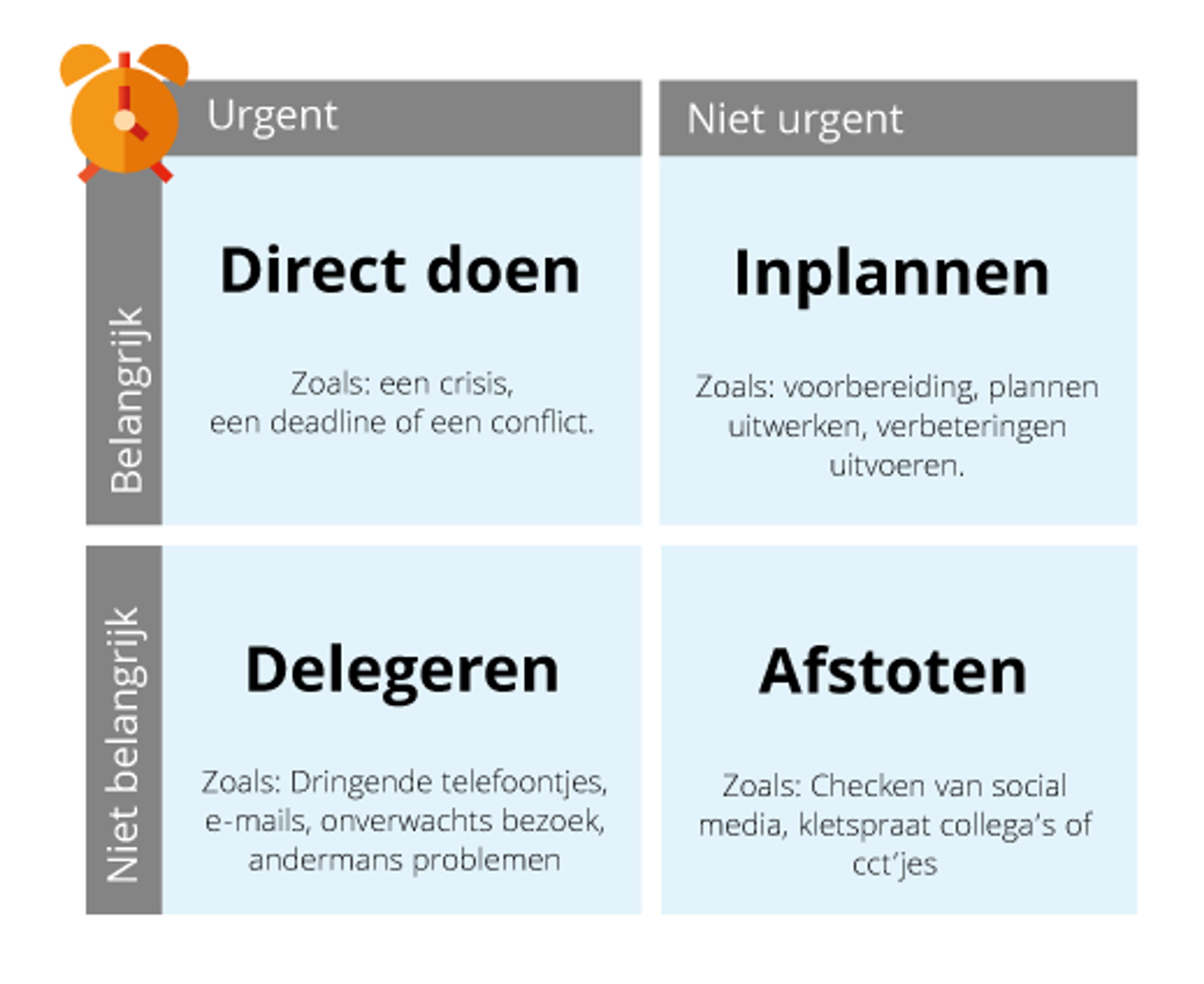
💡Tip: A practical tool that can help with this is the Eisenhower Matrix. It divides your tasks into four categories: urgent and important, important but not urgent, urgent but less important, and tasks you can actually eliminate. By consciously applying this method, you’ll shift your focus from putting out fires to work that’s structurally important. Do you find it difficult to do this on your own? Ask a colleague to help you fill out the matrix.
Overview of Multiple Projects
Many cultural professionals work on multiple projects at the same time—such as a production, a grant application, communications, and collaborations. Without structure, everything can quickly become a jumble. The key is to create a single overview: a central place where you can keep track of all your projects and tasks. By breaking large projects down into smaller steps and scheduling regular check-ins, you can stay on top of things and avoid surprises right before a deadline.
In practice, this also means that you need to establish agreements within your team. If everyone works with their own system, it becomes difficult to maintain an overview. Therefore, work from a single shared system as much as possible and clearly agree on where each task takes place.
Practical tools that can help you with this:
- For a personal overview: Todoist, Google Tasks, or Microsoft To Do can help you keep your own to-do list organized.
- For project management and collaboration: Trello, Asana, Notion, or Monday make projects visual and ensure that everyone knows who is doing what.
- For communication within teams: Slack or Microsoft Teams keep conversations and files in one place.
- For document management and file collaboration: Google Drive, SharePoint, or OneDrive help keep documents centralized and accessible.
- For focus and concentration: Pomodoro apps (such as Focus To-Do or Forest) use 25-minute intervals and short breaks, which are ideal if you get distracted easily.
- For planning and time blocks: UseGoogle Calendar or Outlook to actually schedule tasks and set aside time for focused work.
💡Tip: How you use the tools ismore important than the tools themselves. Choose wisely, keep it simple, and avoid using ten different systems at the same time. A single, clear workflow within your team creates peace of mind, clarity, and better collaboration. Do you find it difficult to do this on your own? Then bring in a specialist to help you and your team choose the best system and put it into practice.
Do Less, Do It Better
Working effectively doesn't mean you have to do more in less time. It's actually about making more conscious choices about what you do and when. By taking a moment to slow down at the start of your workday, you'll be able to work with greater focus and purpose afterward.
It also helps you get to know yourself better. Where do you waste time? When do you work best? And what do you really find important in your work? By regularly reflecting on these questions, you can adjust your behavior and make better choices about what you do and don’t do.
In the long run, this not only leads to better results, but also to greater peace of mind and job satisfaction. And that is essential for maintaining a sustainable work life in an industry that often demands a lot.
💡 Tip: Be sure to schedule time for thinking, too. Not everything has to be production time. Especially in creative fields, having space to think is essential. So make a point of setting aside time in your calendar when you don’t respond to others, but instead reflect or look ahead. Going for a walk or engaging in some other form of physical activity can also help you think—or, conversely, clear your mind for a moment—so that you’ll have room for new ideas afterward.
Read & Listen More
Would you like to learn more about time management and working effectively? If so, here are some good places to start:
- The Seven Habits of Highly Effective People by Stephen Covey
- Article: Time Management Tips for Work
- In the podcast The Process Puzzle , you’ll hear how creators and professionals approach their work processes, decisions, and collaboration.
- Article: Time Management by Jacqueline Smit of YouBloom
- Article: Effective Meetings? Yes, That’s Great! by Miriam Grapendaal, owner and founder of TeamTrain.