From diesel to sustainable power: How Arnhem is making King's Day more sustainable
Thanks to portable batteries, existing power connections, and collaboration between organizers, businesses, and the municipality, most of Arnhem’s festival venues ran on cleaner energy during King’s Day 2026. The pilot demonstrates what sustainable solutions are possible, but also shows that the transition requires thorough preparation and clear agreements.
Why Sustainability Is Necessary
During King’s Day, stages, food and beverage areas, and other festival venues use a lot of electricity for lighting, sound systems, cooling, and kitchen equipment, among other things. That electricity often comes from diesel generators: portable units that burn diesel and emit exhaust fumes, particulate matter, and CO₂ in the process. This is increasingly at odds with Arnhem’s goals for a cleaner downtown. “You don’t want us to end up driving diesel generators into the city center with clean trucks,” says Manon Cornelissen, administrative advisor for the City of Arnhem.
The transition to clean energy also ties in with Arnhem’s history as a city of energy. Cornelissen: “In 2027, we’ll celebrate Arnhem’s 100th anniversary as a city of electricity. Energy is a theme that has traditionally been present throughout the city. That’s why we also want to increasingly switch to clean energy sources within the events sector.”
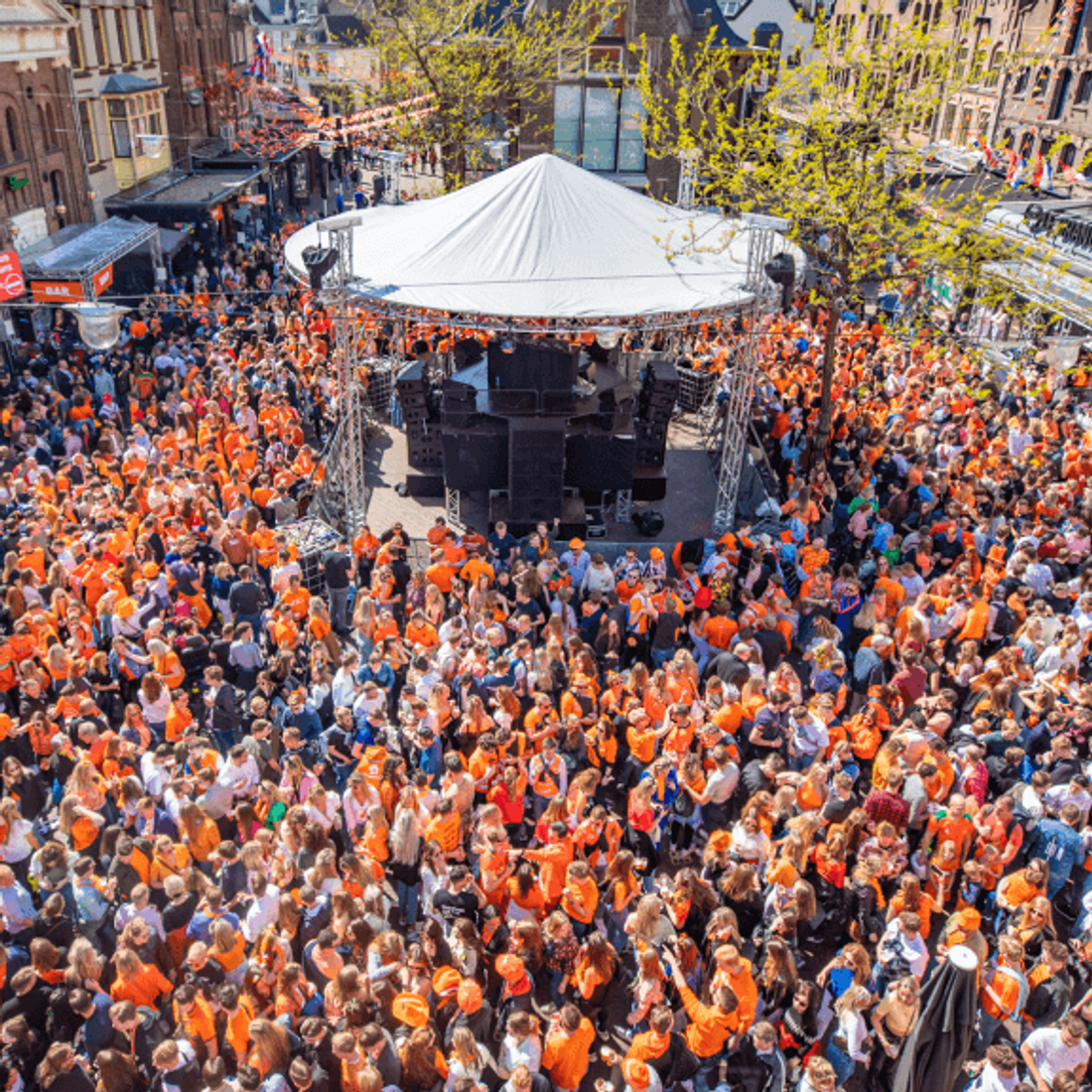
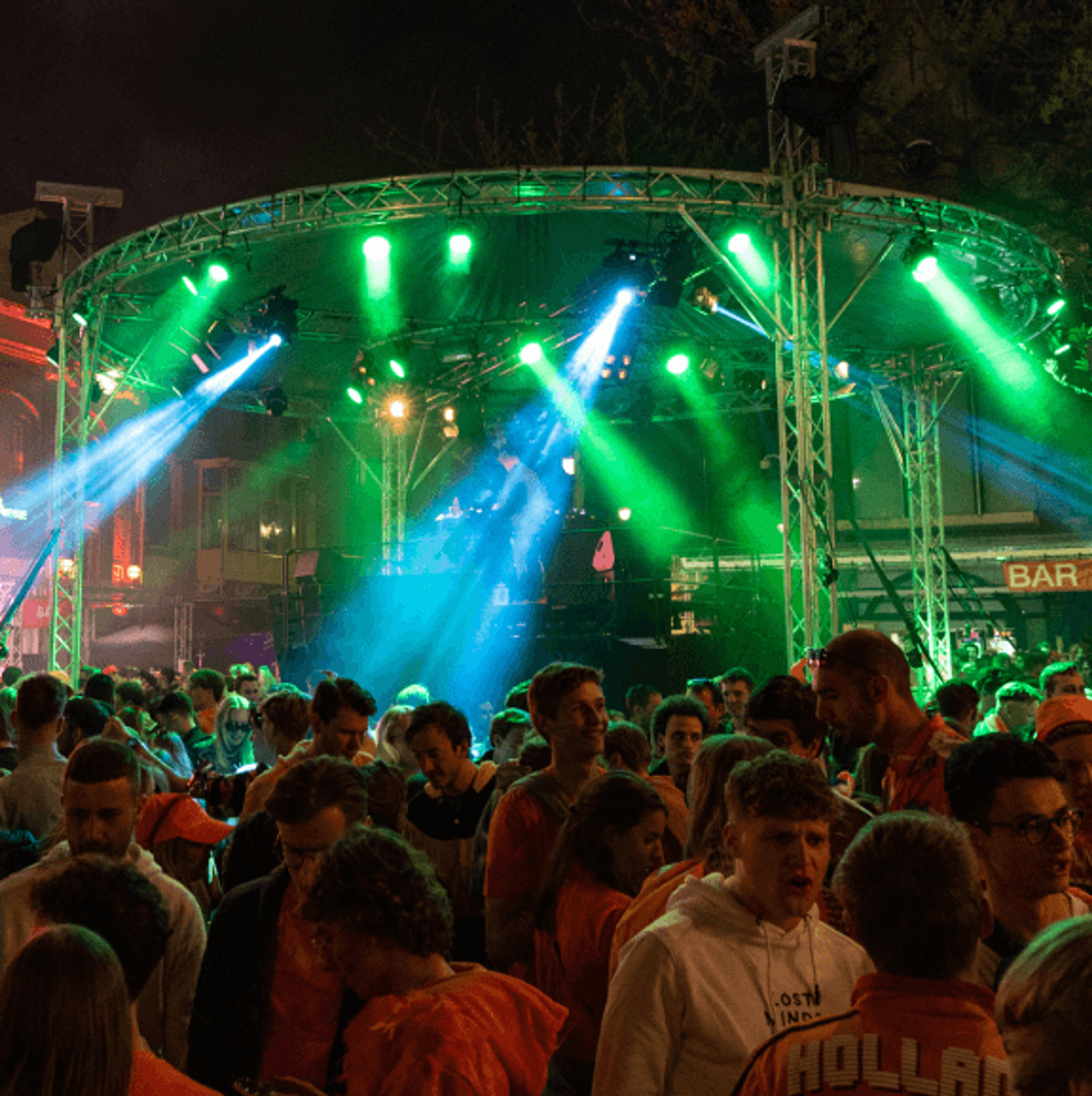
King’s Day was used to test various solutions. Ten of the fifteen festival venues operated without diesel generators. The other five used HVO100 as a renewable interim solution. “We’re showing that it’s possible: organizing large events to be emission-free, step by step,” says Frank Bult, project leader of Zero Emission King’s Day. “Not as a utopia, but as a practical reality.”


The City as an Electrical Grid
For the pilot, portable batteries were combined with existing power connections in the city. For example, the Heeren van Amstel hospitality plaza received power from Theater aan de Rijn. The connection to the AKU fountain was also used to charge a battery, which required the fountain to be temporarily shut off. According to Niek van Onna, program manager for Clean and Emission-Free Construction at Connectr, the biggest challenge isn’t the technology. “Technically, a great deal is possible. The challenge lies much more in the processes surrounding it.” This involves, for example, agreements regarding the use of connections and who makes those decisions.
The battery absorbed spikes in power consumption, so the fixed connection did not have to continuously supply full power. The technologies already existed, but this was the first time they were combined on this scale during a major inner-city event. “We view this as a demonstration project,” says Van Onna. “We’re showing in practice that these solutions can also work at inner-city events.”
Collaboration is just as important as technology
The transition to clean electricity required not only technical solutions but also close collaboration. Organizers, suppliers, municipal departments, the fire department, the environmental agency, and companies from the Connectr network all participated in the pilot. Manon Cornelissen cites this collaborative approach as one of the key successes. “Everyone sees that this is the future. That’s why it’s so great that we can tackle this together. It’s really awesome that we managed to power a number of squares with clean energy for the first time.”
The collaboration also yielded new insights. For example, it became clearer what information the fire department and the environmental agency need to safely assess batteries. After all, what is legally permitted is not automatically appropriate at every location. “You also have to consider what happens if things go wrong and how quickly action can be taken,” says Cornelissen. “That’s not easy during an event like King’s Day, with more than 300,000 people in the city center.”
Planning also proved to be important. For large events, decisions regarding venues, vendors, and equipment are often made months in advance. Anyone who waits until shortly before the event to look for a sustainable alternative to diesel is often too late.
See what's available in the area
An important lesson is that grid congestion—when the power grid is overloaded during peak times—does not mean that electricity is unavailable anywhere. Events often take place in the evenings, on weekends, or on holidays, when offices and other organizations use less electricity. “Take a good look around the area to see where power sources might be available,” advises Cornelissen. For example, a power connection from a theater, restaurant, fountain, or other building can temporarily become part of an event’s power supply.
Reducing power consumption remains the easiest way to achieve savings. Organizers can take a critical look at lighting, cooling, equipment, and the choice of vendors or food trucks. Lower consumption means smaller batteries, less transportation, and lower costs.
Toward a Zero-Emission King's Day
Arnhem wants King’s Day in 2028 to run entirely on clean energy sources. To achieve this, permanent power connections must be utilized more effectively, and organizers, innovative companies, and security services must collaborate even more closely. The city ultimately wants to incorporate the knowledge gained into venue profiles and a roadmap for events in Arnhem. Organizers will then be able to see, for each location, which power connections are available, what capacity is possible, and whether a battery is needed.
Meanwhile, Connectr is investigating whether this approach can also be applied nationwide. According to Van Onna, there is still significant room for improvement, particularly at inner-city events. “In city centers, generators are located close to visitors, staff, and nearby residents. That makes it especially important to reduce emissions in those areas.” Former events alderman Bob Roelofs sees the pilot as an important step: “We want Arnhem to remain a great city to live, work, and celebrate in the future. A King’s Day in Arnhem that runs entirely on sustainable energy is getting closer and closer.”